Scattered Guidelines
Brand voice, UX policies, and prohibited expressions are scattered across multiple documents and collaboration tools, causing the output tone to waver.
This agent searches and combines brand guidelines, UX policies, approval history, and proofreading cases to go beyond simple translation, providing an operational system for generating and validating multilingual UX copy.
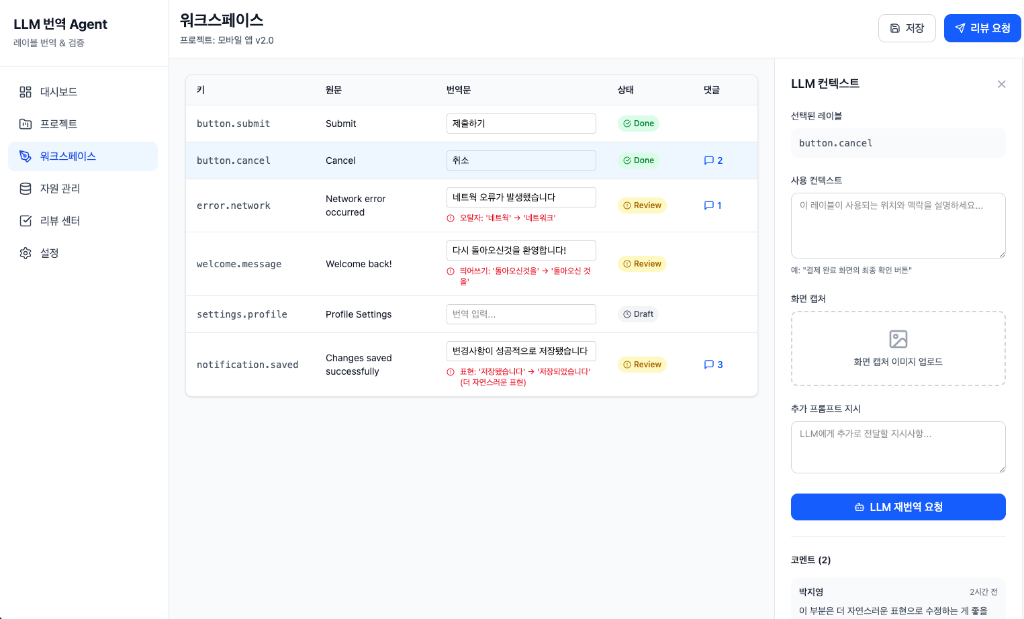
Enterprise organizations already have brand principles and UX writing rules. The problem is that this knowledge is scattered, approved outputs aren't turned into assets, and operational status can't be controlled in one place. This agent fills that gap by tying search, generation, validation, and adoption governance into a single flow.
Brand voice, UX policies, and prohibited expressions are scattered across multiple documents and collaboration tools, causing the output tone to waver.
Even when approved labels and past proofreading cases exist, they aren't systematically reused, so the same reviews are repeated.
Without tracking search quality, prompt versions, and index integrity, quality degradation and failures are detected too late.
Rather than relying on simple vector search, this system employs a four-stage hybrid search tailored to the nature of the data to identify the most suitable policies and examples, thereby enhancing generation quality.
It first checks for exact and similar matches against approved labels to secure the highest level of consistency.
With precise matching based on Korean root extraction, it quickly finds glossary terms and UX policy phrasing.
After semantic search, GPT-4o-mini re-ranks the most suitable guidelines and context.
It automatically extracts high-quality past proofreading cases, inserts them into the prompt, and stabilizes the tone and manner of the output.
Manages prompts as versioned objects and ensures safe promotion from DRAFT to ACTIVE.
Manages vector database conflicts in multi-process environments and supports pre-synchronization backups as well as immediate rollbacks.
Surfaces latency, hit rate, integrity, and progress in real time to speed up operational decisions.
Model performance alone isn't enough. Only by designing search, infrastructure, observability, and prompt adoption together can you achieve reproducible quality in an enterprise environment.
Identifies the most suitable guidelines by hierarchically combining Translation Memory, keyword matching, vector search & re-ranking, and few-shot examples.
Manages vector database conflicts in Gunicorn environments using fcntl file locking and ensures stable operations through incremental synchronization, backups, and rollbacks.
Collects per-step latency, hit rate, index integrity, and bulk indexing progress in real time to quantify search quality.
Manages prompts as versioned objects with type, business unit, model, and status metadata, and automates the DRAFT → ACTIVE → ARCHIVED adoption flow.
What matters at field adoption isn't a flashy demo — it's search strategy, synchronization, observability, and deployment stability.
Hierarchical search from Translation Memory to Few-shot example extraction
Sync modes for missing, incremental, and full scenarios
Continuous monitoring of latency, hit rate, integrity, and progress
Automated backup, rollback, and ACTIVE/ARCHIVED transitions
You can immediately evaluate a production-grade UX writing agent that includes approval-history reuse, hybrid search, prompt governance, and operational visibility.