Lack of Direction
It's unclear where and how to apply AI. Before building a grand system, you should start with AI that immediately helps day-to-day work.
For accurate, hallucination-free answers, we build a complete enterprise RAG system — hybrid search, metadata filtering, RBAC access control, and real-time LLMOps.
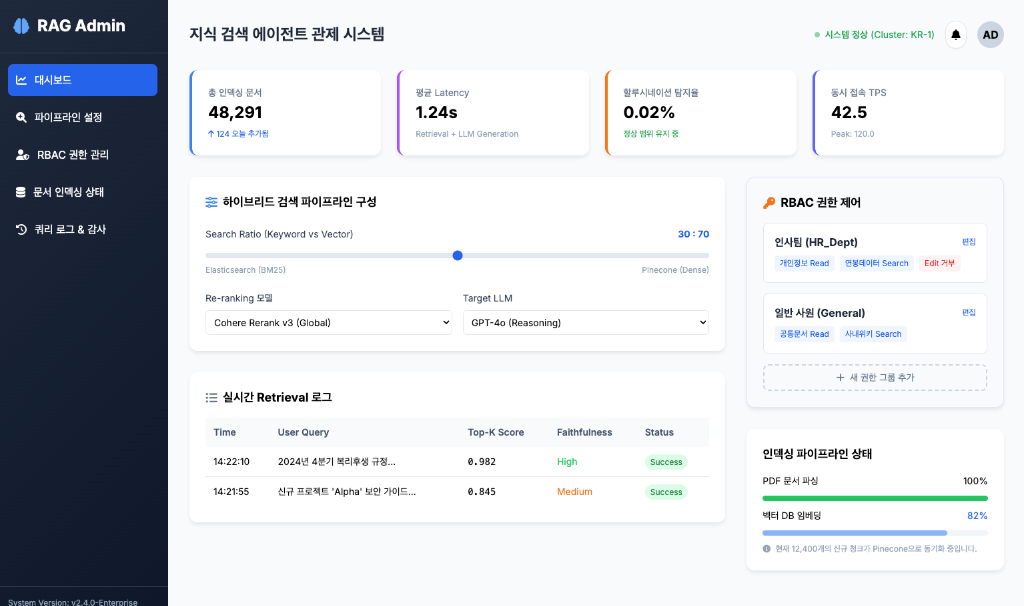
The data is piling up, but it's full of noise, and connecting it to AI directly causes hallucinations. Sending entire documents externally raises security concerns, and it's unclear which data to refine and how. Enterprise RAG only works when search strategy, data preprocessing, and operational visibility are designed together.
It's unclear where and how to apply AI. Before building a grand system, you should start with AI that immediately helps day-to-day work.
The data is piling up, but it's so noisy that there's no certainty it's usable for AI training. Unrefined data actually lowers AI quality.
The enormous costs of building a grand system and the burden of adoption failure are significant. A phased, proven approach is needed.
We build a separate AI infrastructure without touching the customer's existing ERP. RAG technology extracts and transmits only the essential context needed for a question in real time, so there's no concern about data leakage.
This is the touchpoint where users interact with AI. We build a responsive web interface tailored to your purpose — internal custom chatbots, dashboards, and more.
It acts as the gateway connecting the internal and external networks, handling core business logic such as employee access control and logging.
This RAG engine identifies the intent of a query to retrieve relevant documents from a vector database, simultaneously performing metadata filtering and semantic search through self-querying.
An automated pipeline that refines and chunks source data so AI can read it. It automatically extracts metadata with Local LLaMA and splits content into semantic units.
Ensures that data transmitted via API is not used for training OpenAI models, maintaining complete internal security.
Processes defense, finance, and healthcare data with Local LLaMA running on internal GPU servers without an internet connection.
Tracks hallucination detection rate, response accuracy, latency, and token cost in real time to manage AI quality transparently.
It is not merely a simple vector search. To achieve reproducible quality in an enterprise environment, you must design a system that integrates hybrid search, metadata self-querying, RBAC-based access control, and real-time LLMOps.
An LLM analyzes the natural language query and separates it into semantic search terms and metadata filters (such as year or department). After narrowing the search space through pre-filtering, the top-K results are retrieved using ANN vector search.
It automatically injects the questioner's rank and department info into metadata filters, so searches occur only within documents the user is authorized to view. Enterprise security policies are enforced at the system level.
Meta LLaMA on internal GPU servers reads documents, automatically extracts metadata, and chunks content into semantic units. It operates without external internet access to safely process sensitive data in air-gapped environments.
With automatic hallucination detection, a user RLHF feedback loop, and a token-cost optimization dashboard, you operate AI as a transparent glass box rather than a black box. It automatically generates error notes so the AI continuously improves.
Adoption results are proven by real operational figures, not flashy demos. The true metrics are hallucination detection rate, response latency, search accuracy, and security compliance rate.
Response reliability measured through real-time Ground Truth comparison analysis
Hallucination rate blocked at the source via metadata pre-filtering
Response speed achieved through pre-filtering + ANN search optimization
Application rate of automated document access control based on user permissions
You can immediately evaluate a complete enterprise RAG system that includes accurate hallucination-free answers, metadata Self-Querying, RBAC access control, and LLMOps quality monitoring.