AI Adoption Without Guidelines
Generative AI tools are being adopted rapidly in the field, but there's no governance framework to defend against sensitive data leaks and prompt injection.
By connecting detection → monitoring → feedback loop into a single security full-stack, we block sensitive data leaks and threats in real time and continuously enhance detection quality.
Generative AI tools like ChatGPT and Claude are rapidly penetrating the field, but there's no way to track what was entered. Adopting AI without proactive defenses against sensitive data leaks, prompt injection, and model drift is like storing valuables with the door left open.
Generative AI tools are being adopted rapidly in the field, but there's no governance framework to defend against sensitive data leaks and prompt injection.
You can't track who entered what data into AI and when, making post-hoc audits impossible and accumulating compliance risk.
Even when policies are updated, the detection model stays the same, so false positives and false negatives repeat and response quality doesn't improve over time.
It doesn't stop at simple blocking. Four stages — PII detection → threat monitoring → labeling feedback → policy engine — are organically connected so security quality automatically rises as you operate.
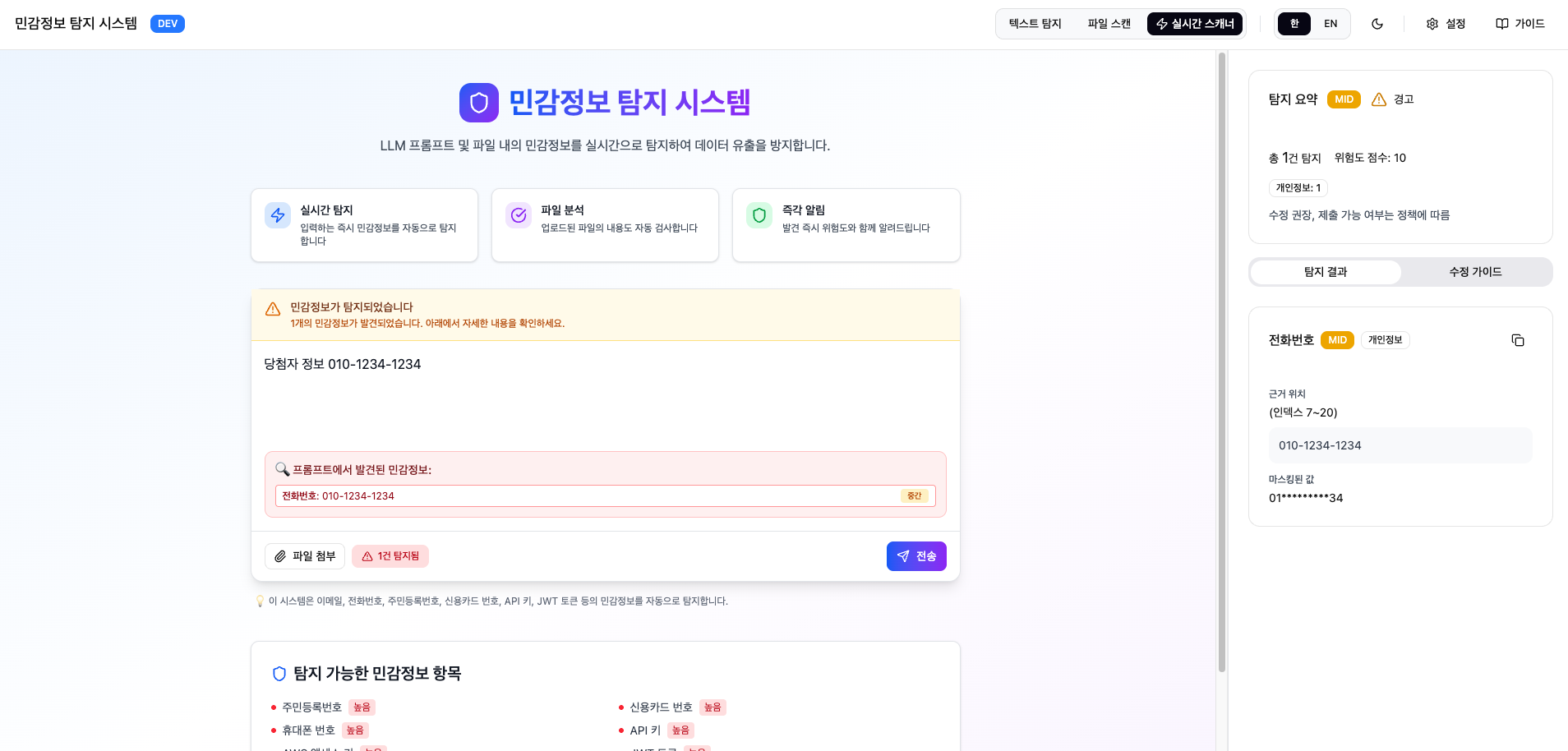
Scans prompts and attachments in real time to classify personal and confidential data and blocks it instantly before transmission.
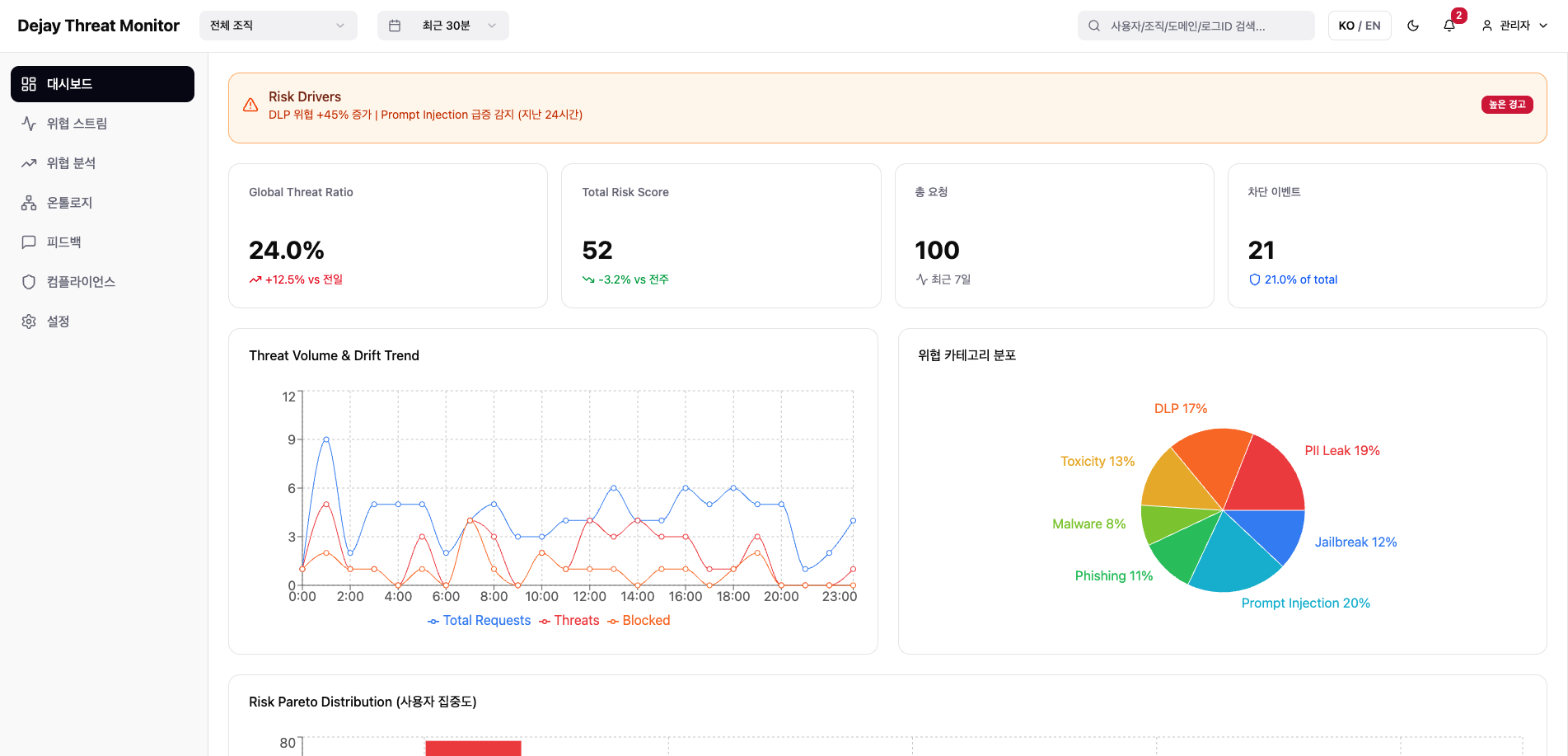
Integrates monitoring of risk ratios, blocking events, and attack types by organization in a single dashboard to immediately identify anomalies.
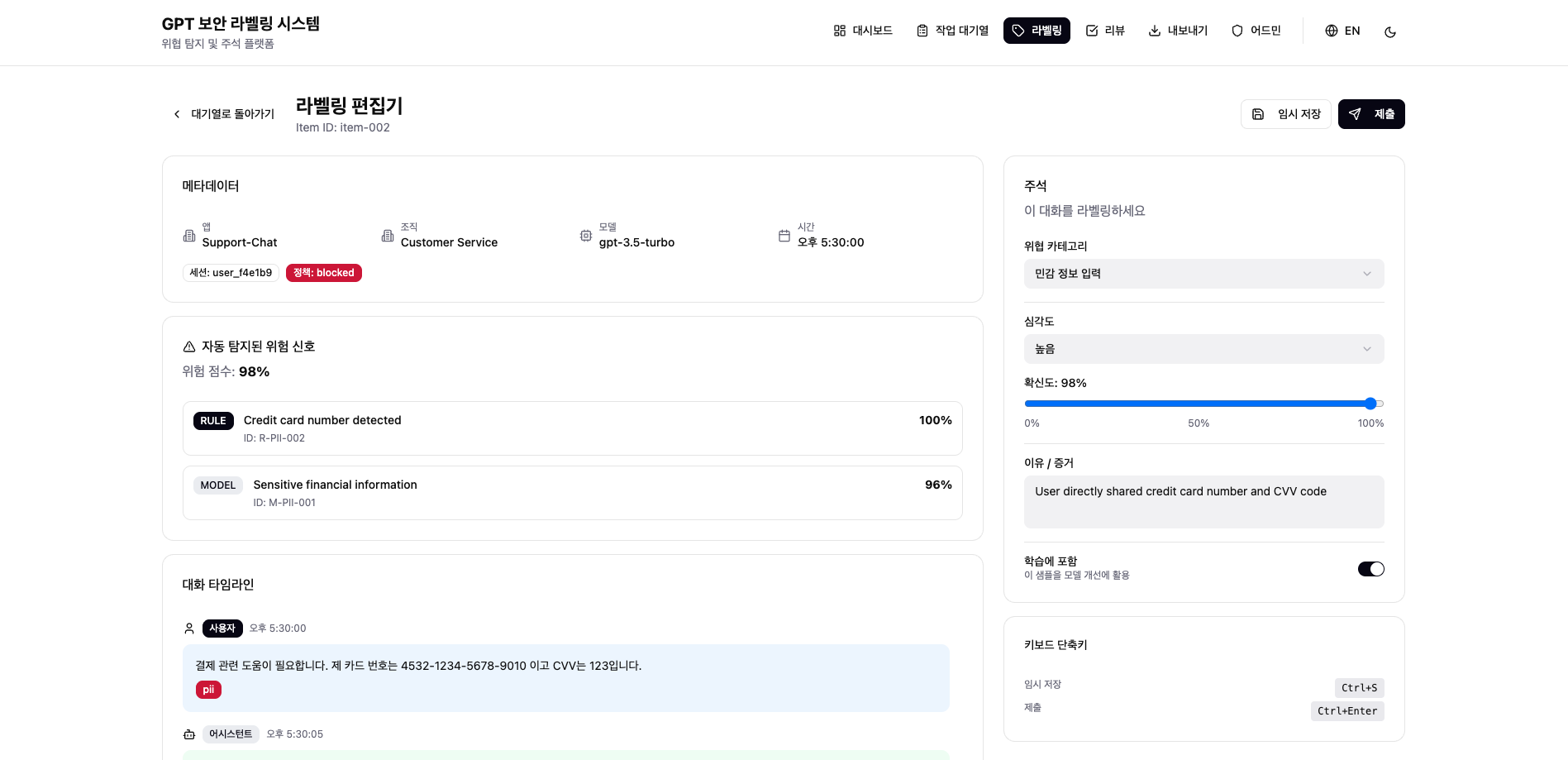
When security staff label false positives and true positives, the results are automatically fed back into the detection policy's training data, continuously improving quality.
Manages differentiated security policies at the organization, business unit, and user levels, and applies policy changes to the detection pipeline with zero downtime.
Applies policy changes to the detection pipeline instantly with no service interruption.
Retains all detection and blocking events as logs to support compliance audits.
Periodically detects changes in model behavior to alert on unexpected quality degradation in advance.
It's not security that ends with a single block. True security requires a structure where detection quality is learned, policies are automated, and operators can grasp everything at a glance.
Combines rule-based patterns with context analysis to block resident registration numbers, card numbers, and internal strategy documents before prompt transmission.
View blocking counts by organization, risk type distribution, and time-series events at a glance so security operators can act immediately.
Feeds labeling results back as training data to continuously improve the detection model and increase adaptability to new threat types.
Sets differentiated security policies by organization, department, and role, and automates policy version history and change-approval flows to maintain compliance.
The real metric for AI security isn't how much you blocked, but how accurately you detect and how quickly you improve.
Instant detection and blocking of sensitive data before prompt/file transmission
3-step security full-stack: detection → monitoring → feedback loop
Zero-downtime application of policy changes to the detection pipeline
Continuous detection quality enhancement via labeling feedback
You can immediately evaluate an enterprise AI security full-stack that includes PII detection, threat monitoring, a feedback loop, and policy governance.